



In this article, Max Schloemann explains why physician reimbursement is falling behind rising private practice costs, how that pressure is affecting independent practices, and what it could mean for patient access and choice.
For years, I have heard the same frustration from physicians in private practice, particularly surgeons and specialists: they are seeing more patients, performing more procedures, and facing higher operating costs, yet reimbursement has not kept pace. Some procedures now pay a fraction of what they once did, leaving physicians under pressure to increase volume even though every additional patient requires more time, staff, documentation, supplies, and follow-up care.
That is why physician reimbursement deserves a much bigger conversation, especially when payment can vary significantly by insurer, specialty, procedure, location, site of care, and negotiated contracts.
Reimbursement Is Falling Behind
There is no single reimbursement rate for physicians in the United States. What a practice is paid can vary considerably based on the insurer, specialty, procedure, geographic market, site of care, and the individual contract a practice has been able to negotiate.
However, across multiple procedural and surgical specialties, the long-term trend is clear: reimbursement has lost ground after accounting for inflation.
A recent study found that inflation-adjusted Medicare physician reimbursement for common hip and knee replacement procedures fell by roughly 56% between 2000 and 2024. Similar studies have documented significant declines in specialties including urology, otolaryngology, general surgery, and vascular surgery. At the same time, reimbursement can vary widely depending on the payer, procedure, and market, leaving private practices with an increasingly unpredictable revenue picture.
In other words, many physicians are being paid less for the same work while the cost of providing that care continues to rise. That gap is what makes the current economics of private practice so difficult.
Reimbursement Is Practice Revenue, Not a Physician’s Paycheck
When the public hears a call for higher physician reimbursement, it can be easy to reduce the issue to a question of physician salaries. Doctors are generally well compensated professionals, so why should they be paid more?
That framing misses how a private medical practice actually operates.
When an insurer reimburses a practice for a patient visit or procedure, that payment does not simply become the physician’s income. It supports the entire operation required to provide that care. Private practices employ nurses, medical assistants, receptionists, billing specialists, practice managers, and other professionals. They pay for office space, medical equipment and supplies, software, utilities, employee benefits, taxes, compliance, professional liability insurance, and countless other necessities.
A physician can earn a good living while running a practice with shrinking margins, because a successful practice needs significant revenue just to cover the rising cost of care. MGMA reported in June 2026 that 84% of medical groups said their year-to-date operating costs were higher than they were at the same point in 2025.
When expenses are rising that quickly, reimbursement cannot remain disconnected from what it costs to provide care.
Doctors Cannot Keep Solving the Problem by Seeing More Patients
One of the things I hear from surgeons is that they sometimes need to perform considerably more procedures to generate the same revenue they earned years ago.
That is not a sustainable long-term strategy.
Medicine is not an industry where a business can simply double production without consequences. Every additional patient requires physician time, staff time, scheduling, documentation, billing, supplies, and follow-up. Surgical procedures carry even greater demands and responsibility.
There are only so many patients a physician can safely see in a day and only so many procedures a surgeon can perform. Increasing volume may help compensate for lower reimbursement in the short term, but it cannot be the permanent answer to rising costs.
At some point, reimbursement itself has to reflect the realities of providing care.
Private Practice Is Already Becoming Less Common
The financial pressure on independent practices deserves particular attention because private practice itself has been shrinking.
According to the American Medical Association, 42.2% of physicians were working in private practices in 2024, meaning practices wholly owned by physicians. In 2012, that number was 60.1%. That represents an 18-percentage-point decline in just over a decade.
The shift is even more pronounced in certain specialties. The AMA found low private-practice participation in cardiology, where only 30.7% of physicians were in private practices in 2024. Some specialties remain more independent. Orthopedic surgery, for example, was at 54%, while ophthalmology was at 70.4%.
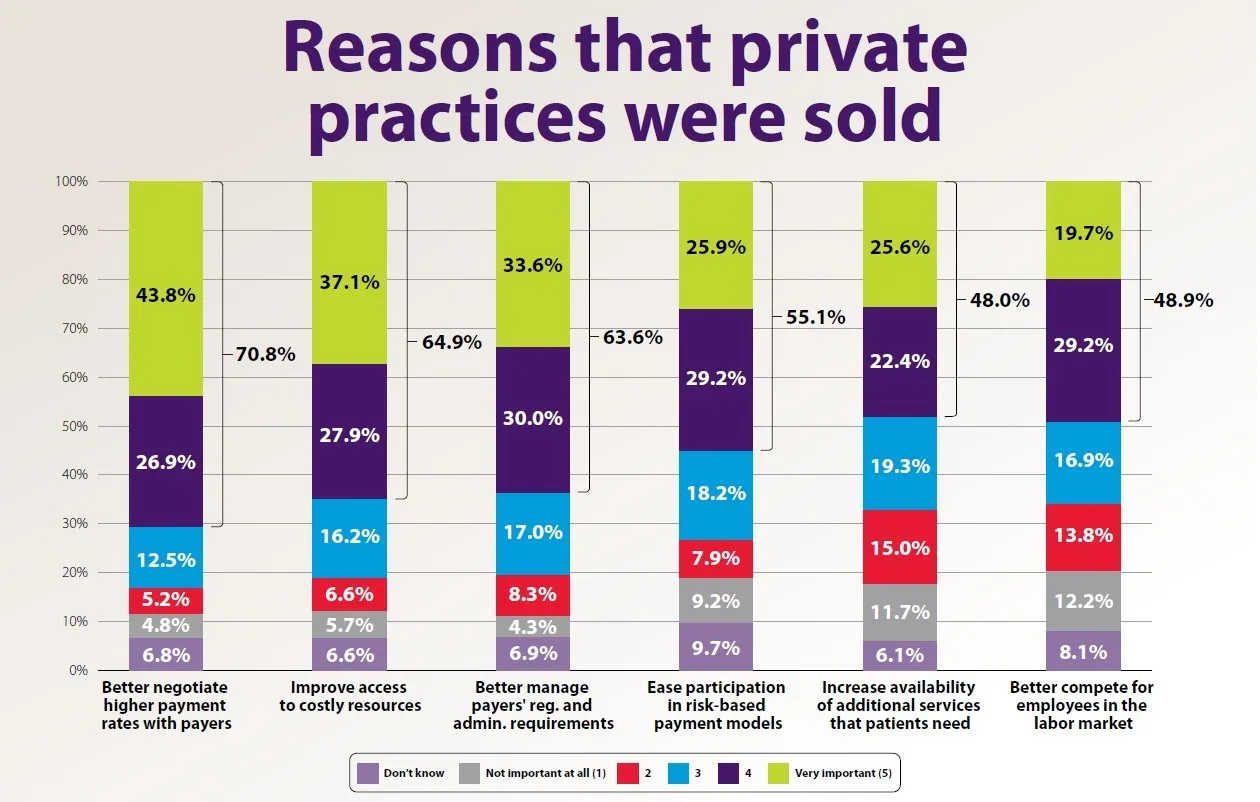
There are many reasons physicians choose employment over ownership, and reimbursement is certainly not the only one. Administrative burden, technology costs, negotiating power, lifestyle considerations, consolidation, and access to capital all matter. But financial sustainability is part of that equation. Among physicians whose private practices had been sold, almost 80% said the need to better negotiate higher payment rates with payers was an important or very important reason behind the sale.
If a doctor can no longer make the numbers work independently, becoming employed by a hospital, health system, or larger organization can start to look less like one option among many and more like the only reasonable one.
That should matter to anyone who values independent medicine.
What Happens to Patients When the Economics Don’t Work?
The financial strain on private practices does not stay inside the walls of the practice. Eventually, it reaches the patient.
When reimbursement fails to cover the true cost of providing care, physicians are forced to make difficult decisions about which services they can continue offering, which insurance contracts they can participate in, and whether remaining independent is financially realistic at all. Those decisions may begin as business decisions, but they can quickly become access-to-care decisions.
If reimbursement from a particular insurer does not justify the cost of providing the service, the practice may eventually decide to stop accepting that insurance entirely. In other cases, a physician may limit the number of patients covered by certain plans, refer more services elsewhere, or decide that joining a larger organization offers more financial stability than continuing to operate independently.
Now the patient is no longer choosing primarily based on which doctor they trust, who has the best experience, or who was recommended to them. They are choosing from the physicians their insurance plan makes available.
That is how a reimbursement problem becomes an access problem. If more independent physicians leave certain networks or leave private practice altogether, patients can end up with fewer choices.
A healthcare system with financially viable independent practices gives patients more places to seek care, more physicians to choose from, and more opportunities to find a provider who fits their needs.
If we want patients to have meaningful choices, then physicians need an economic environment that allows them to keep providing that choice.
Not All Payers Reimburse Physicians Equally
Another uncomfortable reality of private practice is that not every payer reimburses at the same level.
A physician may genuinely want to make care available to everyone, but the practice still has payroll due every two weeks. Rent still has to be paid. Supplies still have to be ordered. Insurance premiums still come due.
If reimbursement is consistently inadequate, physicians can be put in the position of deciding which payer contracts they can realistically continue to accept. That is not good for physicians, and it is certainly not good for patients.
A healthier reimbursement environment gives practices more flexibility to participate with insurers and continue serving a broader group of patients.
Higher Physician Reimbursement and Affordable Healthcare Are Not Opposing Goals
None of this means we should ignore the cost of healthcare . Patients are also dealing with higher premiums, deductibles, prescription expenses, and out-of-pocket costs. Making healthcare more affordable is an important goal.
But reducing what physicians receive for providing care cannot be the entire affordability strategy.
Healthcare spending involves far more than the physician delivering the service. There are insurers, health systems, pharmacies, pharmaceutical companies, administrators, vendors, facilities, and many other participants in the system.
The amount a patient or employer pays into healthcare is not the same as the amount an independent physician ultimately receives for providing care.
We should be able to acknowledge both realities. Patients need affordable healthcare, and doctors need reimbursement that allows them to operate financially sustainable practices.
Those goals do not have to be in conflict. In fact, those goals may be more connected than they initially appear. A healthcare system in which independent physicians can remain financially viable preserves another option for patients outside of increasingly consolidated organizations.
Private Practice Is Worth Protecting
At MEDPLI, we spend our days working with physicians, surgeons, and medical practices. We hear about the challenges they face with malpractice insurance, but we also hear about everything else that comes with running an independent practice.
We hear when expenses go up. We hear when a physician is frustrated with what an insurer pays for a procedure. We hear when maintaining revenue means adding more patients or procedures to an already busy schedule.
Those conversations are why I believe this issue deserves more attention.
And increasingly, the data reflects what physicians have been telling us directly. Reimbursement for many surgical procedures has lost significant ground after inflation. More than eight in 10 medical groups report rising operating expenses. The share of physicians working in private practice has fallen from 60.1% to 42.2% since 2012. And among physicians whose practices were sold, more than seven in 10 pointed to the need for stronger payer negotiating leverage as an important factor.
Those trends are connected by a simple question: Can physicians still make the economics of independence work?
This is not a call to make healthcare more expensive for patients. It is a call to recognize that there is a real cost to providing high-quality medical care and that the physicians taking on that work, responsibility, and risk need a reimbursement system that reflects it.
If we want patients to continue having access to independent physicians, experienced specialists, and meaningful choices about who provides their care, private practice has to remain financially possible.
That means physicians need advocates. It means the cost of running a practice has to be part of the reimbursement conversation. And after years of payments falling behind practice-cost inflation, it means we need to take seriously what physicians have been saying for a long time:
Fair reimbursement is not only about what we pay doctors. It is about whether we make it possible for independent medicine to survive.
About the Author
Max Schloemann is a medical malpractice insurance broker helping physicians and surgeons secure Medical Professional Liability coverage. A Magna Cum Laude graduate of Southern Illinois University’s College of Business, he was named Outstanding Management Senior.
Max began his career in 2008 at an industry-leading firm and founded MEDPLI in 2017 to guide private practice doctors and physicians in transition through the complexities of malpractice insurance.
Outside of work, Max, his wife Kristen (a Physician Assistant), and their four kids enjoy the outdoors and attending the kids’ sporting events. Contact Max for malpractice insurance questions.
Latest from the Medical Malpractice Insurance Blog

Physician reimbursement is falling behind rising private practice costs. See the data, impact on patient access, and why it matters. Read here.

The Doctors Company is dropping New Jersey physician malpractice rates by an average of 25.1%, effective October 1, 2026. Here's what it means for your premium.

The Doctors Company completed its acquisition of ProAssurance. See what it means for current policyholders and the malpractice insurance market going forward.

Malpractice Payouts for Florida OBGYNs Are High Florida OB/GYN [...]